
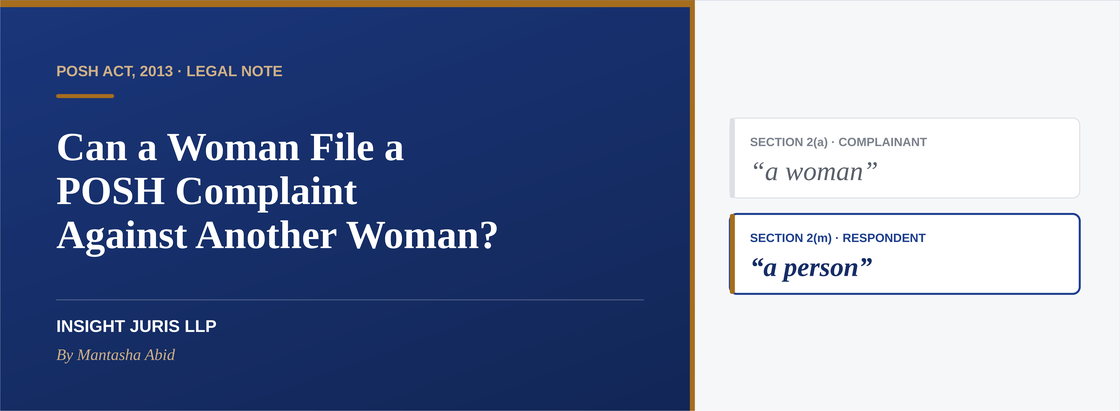
Woman Against Woman: Is a POSH Complaint Maintainable?
The gender-neutral respondent under the Sexual Harassment of Women at Workplace Act, 2013
By Mantasha Abid | Insight Juris LLP
One of the most persistent misconceptions about India's workplace sexual harassment law is that it governs only male-on-female misconduct. It is a misconception that costs employers dearly. Internal Committees routinely reject complaints at the threshold on the reasoning that "both parties are women, so the POSH Act does not apply" — and in doing so, they commit a jurisdictional error that exposes the organisation to writ proceedings, adverse findings, and penalties under Section 26 of the Act.
The correct position is settled. A woman can lodge a complaint of sexual harassment under the POSH Act against another woman, and the Internal Committee is bound to inquire into it. This note explains the statutory basis for that position, the judicial authority that confirms it, and what employers must do about it.
The statutory asymmetry: a gendered complainant, a gender-neutral respondent
The answer lies in reading two definitions in Section 2 side by side.
Section 2(a) defines an "aggrieved woman", in relation to a workplace, as "a woman, of any age whether employed or not, who alleges to have been subjected to any act of sexual harassment by the respondent". The complainant side of the equation is therefore expressly gendered. Only a woman may invoke the Act.
Section 2(m), however, defines "respondent" as "a person against whom the aggrieved woman has made a complaint under section 9". The legislature did not say "a man". It did not say "a male employee". It used the word person — a deliberately neutral term that, read with Section 2(f) ("employee") and the General Clauses Act, 1897, plainly encompasses individuals of any gender.

Figure 1. The complainant is defined by gender; the respondent is not.
This asymmetry is not an accident of drafting. It reflects the constitutional foundation of the statute: Article 15(3) permits protective legislation for women, and the Act was enacted to give effect to the Vishaka guidelines and India's obligations under CEDAW. The protection is calibrated to the complainant's vulnerability, not to the perpetrator's gender.
Section 3(1) reinforces this. It states simply that "no woman shall be subjected to sexual harassment at any workplace" — a prohibition framed around the harm suffered, with no qualification as to who inflicts it.
Section 2(n) defines sexual harassment by reference to conduct: unwelcome physical contact and advances, a demand or request for sexual favours, sexually coloured remarks, showing pornography, and any other unwelcome physical, verbal or non-verbal conduct of a sexual nature. Every one of these acts is capable of being committed by a woman against a woman. Section 3(2), which lists the circumstances that may amount to sexual harassment — implied or explicit promise of preferential treatment, threat of detrimental treatment, interference with work, humiliating treatment likely to affect health or safety — is likewise entirely gender-agnostic. Quid pro quo harassment by a female supervisor is, on the plain text, as much an offence under the Act as the same conduct by a male supervisor.
Finally, Section 9, which prescribes the complaint mechanism, contains no restriction whatsoever on the gender of the person complained against. There is simply nothing in the statutory scheme from which a same-gender bar could be inferred.
The leading authority: Dr. Malabika Bhattacharjee
The question came squarely before the Calcutta High Court in Dr. Malabika Bhattacharjee v. Internal Complaints Committee, Vivekananda College & Others, W.P.A. 9141 of 2020, decided on 27 November 2020 by Justice Sabyasachi Bhattacharyya.
The petitioner, a woman against whom a complaint had been filed by another woman, challenged the maintainability of the proceedings before the Internal Complaints Committee. Her argument was straightforward: sexual harassment under the 2013 Act, she contended, could only occur between persons of opposite genders, and a complaint by one woman against another was therefore incompetent.
The Court rejected the argument and upheld the maintainability of the complaint. Analysing Sections 2(m), 2(n), 3(2) and 9, the learned Judge held that the definition of "respondent" is not gender-specific, and that the concept of sexual harassment under the Act must be understood as dynamic rather than static — capable of evolving with changing social realities.
The core of the reasoning is worth quoting in substance: sexual harassment as contemplated by the 2013 Act pertains to the dignity of a person, which relates to her or his gender and sexuality. A person of any gender may feel threatened and sexually harassed when their modesty or dignity is offended, irrespective of the sexuality and gender of the perpetrator. The Court further observed that same-gender complaints are "not improbable, particularly in the context of the dynamic mode which the Indian society is adopting currently", and noted that a contrary reading would render the protective purpose of the Act illusory in a significant class of cases.
The writ petition was dismissed. The judgment remains the leading authority on the point and has been consistently followed in practice by Internal Committees and advisory practitioners.
What this does not mean: two important limits
Two qualifications must be stated clearly, because they are frequently confused with the proposition above.
First, the complainant must still be a woman. The POSH Act does not permit a man to file a complaint before an Internal Committee, and complaints by men against men are outside its scope. The Supreme Court has declined invitations to read complete gender neutrality into the statute, taking the view that expanding the class of complainants is a matter for Parliament rather than for judicial legislation. Male employees who face harassment must be dealt with under the employer's own service rules, code of conduct, or a separate gender-neutral anti-harassment policy — a course many well-advised organisations now adopt voluntarily.
Second, the criminal law does not track the POSH Act. Section 75 of the Bharatiya Nyaya Sanhita, 2023 — the offence of sexual harassment — opens with the words "a man committing any of the following acts", and is therefore incapable of being invoked against a female respondent. A woman found guilty by an Internal Committee of sexual harassment can face the full range of consequences under the Act — action for misconduct under the applicable service rules, written apology, warning, withholding of promotion or increment, termination, and payment of compensation determined under Section 15 and recoverable from her salary under Section 13(3)(ii) — but she cannot be prosecuted under Section 75 BNS on the same facts. (Certain neighbouring provisions operate differently: Section 79 BNS, which punishes words, sounds, gestures or acts intended to insult the modesty of a woman, begins with "Whoever" and is therefore not confined to male offenders.) This divergence between the civil-remedial and penal regimes is a real drafting gap, and one that counsel advising either side should be alive to.
The wider judicial trend
The purposive approach in Malabika Bhattacharjee is consistent with the direction the courts have taken since. In Dr. Sohail Malik v. Union of India, 2025 INSC 1415 (Maheshwari and Bishnoi JJ., decided 10 December 2025), the Supreme Court held that the Internal Committee of the aggrieved woman's own workplace has jurisdiction to inquire into a complaint even where the respondent is employed in a different department. The Court read the words "where the respondent is an employee" in Section 11 as descriptive of procedure rather than as a jurisdictional fetter, construing Sections 2(m), 2(o), 9, 11, 13 and 19(f) so as not to leave the complainant remediless. In July 2025, the Delhi High Court in Dr. Amit Kumar v. University of Delhi extended the concept of "workplace" under Section 2(o) to digital interactions on platforms such as WhatsApp and Facebook where they arise out of a professional relationship.

Figure 2. The judicial arc — from filling a legislative vacuum to construing the Act by its purpose.
The common thread is unmistakable: courts are construing the POSH Act by reference to the mischief it addresses, not by reference to narrow textual constraints that the statute does not contain. An Internal Committee that declines jurisdiction on a technical or assumed limitation is, on current authority, on weak ground.
Compliance takeaways for employers
- Audit your POSH policy. If it describes the respondent as "he", "him", or "the male employee", it is inconsistent with Section 2(m) and should be amended to refer to "any person, irrespective of gender".
- Train the Internal Committee on threshold jurisdiction. Members must understand that the gender of the respondent is irrelevant to maintainability. Rejecting a complaint on that ground is a reviewable error.
- Do not dilute the inquiry. A same-gender complaint attracts the identical procedure — Section 11 inquiry within ninety days, interim relief under Section 12 where warranted, report under Section 13 within ten days, and the appeal remedy under Section 18.
- Apply Section 14 evenly. Protection against malicious or knowingly false complaints applies in same-gender matters exactly as elsewhere, and only after a finding of malicious intent on inquiry — never as a reflex response to an inconvenient complaint.
- Consider a parallel gender-neutral policy. Since the Act cannot accommodate male or non-binary complainants, a well-drafted internal code closes the gap and reduces the risk of discriminatory treatment claims.
- Sensitise the workforce. Employee awareness programmes under Section 19 should expressly address same-gender conduct, so that potential complainants know the forum exists and potential respondents understand that it applies to them.
Conclusion
The text of the POSH Act, read as it stands, admits of only one answer: the complainant must be a woman, the respondent may be anyone. Dr. Malabika Bhattacharjee confirms it, and the subsequent expansion of the Act's reach by the Supreme Court and the High Courts makes any narrower reading untenable. Employers who have not aligned their policies, committees and training to this position are carrying an avoidable and entirely foreseeable risk.
Insight Juris LLP advises employers on POSH policy design, Internal Committee constitution and training, inquiry conduct, and Section 21 and Section 22 reporting compliance. For assistance with a specific matter, please write to us.
Disclaimer: This article is intended for general information only and does not constitute legal advice. Readers should seek independent professional advice before acting on any part of it. The position stated is as of the date of publication.